Enchantment at the Crypt

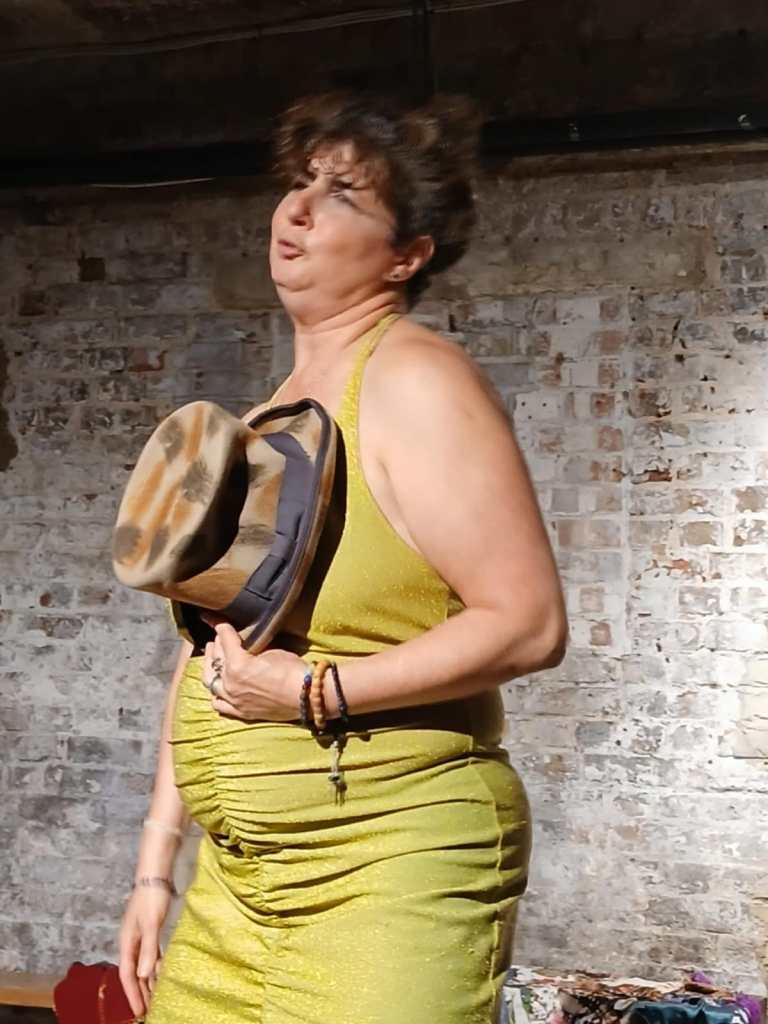
On Saturday I performed at the Crypt Gallery in Euston (London, UK) with my friend and fellow performance artist Limor! We each presented a one woman show for over an hour, and both of our shows connect with our most dearly departed loved ones. In my play ‘From the 7th Layer’, my Mother’s voice is heard, talking about her physical disability and how in her dreams she has a young able body. She looked forward to sleeping very much because being able to move easily and freely in her dreams was so incredible. Here is a clip where I imagine her in spirit.

Limor performs several characters in her show, who are all living inside of her, including her departed son Zohar. In 2022 a tragic accident ended his life on this plane, when he was just 22 years old. He was about to begin a Masters degree in Physics, and the only time I met him was a few weeks before he died. It was Limor’s birthday party, and he recognised me from one of my performances (‘Dreamtime‘) he’d watched on video with his Mum. That play was about a group of women friends including Limor, and she was unable to attend live. She felt nervous about seeing a version of herself portrayed by me! Zohar encouraged her to watch it, and said he would watch it with her. He was very complimentary to me about the play, and I found him extremely charming. He was so very smart and positive. The next thing I knew about him, I was at his funeral with the many grief-stricken friends and family. As is the Jewish tradition, the family then sat shiva for a week or so, and I met some of his beautiful friends who shared stories about him.

Limor and I share an interest in the metaphysical as well as creating our own performances. We used to be part of a red tent circle together. The play I performed in 2022 with Limor as inspiration for one of the characters, was a fictionalised story about the red tent group. In it, I had cast Limor as a medium, contacting the spirit world on my behalf as I was having difficulty getting through to a long lost ancestor. My Mother, already passed, was acting as a troublesome guide who interfered with my connection! Luckily Limor’s character Lila, was able to channel my great great aunt (who is the main character in my ‘Bromelia Bohemia’ play.) There is something delightfully anticipatory about our creative journey together.

Meeting up to rehearse and prepare has meant a lot for me, as doing it all on your own becomes limited after a while. You need outside eyes to watch you and feedback. You need someone to discuss the ideas and possibilities with. It adds to the experience of the process to share it with someone who is equally invested. Destiny brought us together for this as we are mutually able to assist each other.

As you get older you can feel further away from fellow performers, let alone those on a similar path. We want to free ourselves from our shadows, which is of course impossible, but we are working with performance as a way of raising our vibration, communicating our essence, and moving more into the light. There is a way that by healing ourselves we may also reach others and help to enable transformation in them. Theatrical performance is our medium. It encompasses being in our bodies as well as working with words, sometimes singing. We want to draw the audience into our world so they may imagine it for themselves, or be reminded of their own inner lives.

There is the art of how much to say, and what to leave for others’ imaginations, and sometimes discerning that is a way Limor and I may help each other. After we’ve told our story so many times, we may lose sight of its effect. The inner work which happens alongside creating, preparing and performing concerns self worth and self love and the development of those. While this is our process, these areas of personal growth are common to many many people, and by expressing some of our experience publicly we may enable or trigger others’ growth. We want to let go of what has dogged us and instead focus on what inspires us and makes us happy. A little contrast is needed to heighten the uplift, yet not excessively. Finding the most enhancing balance is part of how we help each other.

Questions I ask myself include; how does my less than year old show still feel fresh? What is it trying to say? I’m not sure. I would like it to be completely fresh. What do I want to express? Where I am now. Once I play the soundtrack and say the lines, I remember the purpose. It has a quality that transcends total freshness; it seems to stand up artistically, though I might not feel like performing it still in say three years. Let’s see where I am then.

We have rehearsed in local parks in Deptford and Greenwich, as well as Hampstead Heath, and also in the Telegraph Hill Centre. We love being outdoors and the recent weather has been ideal. We feel drawn to create work which is designed to be out in nature and that may be our next project together. The next performance dates we each have lined up are in the Deptford X art festival close to where we both live. Limor’s will be at Co-op Pepys community art project on Sunday July 13th, and mine at the Royal Albert pub on Thursday 24th July. Please join us!

change of tempo

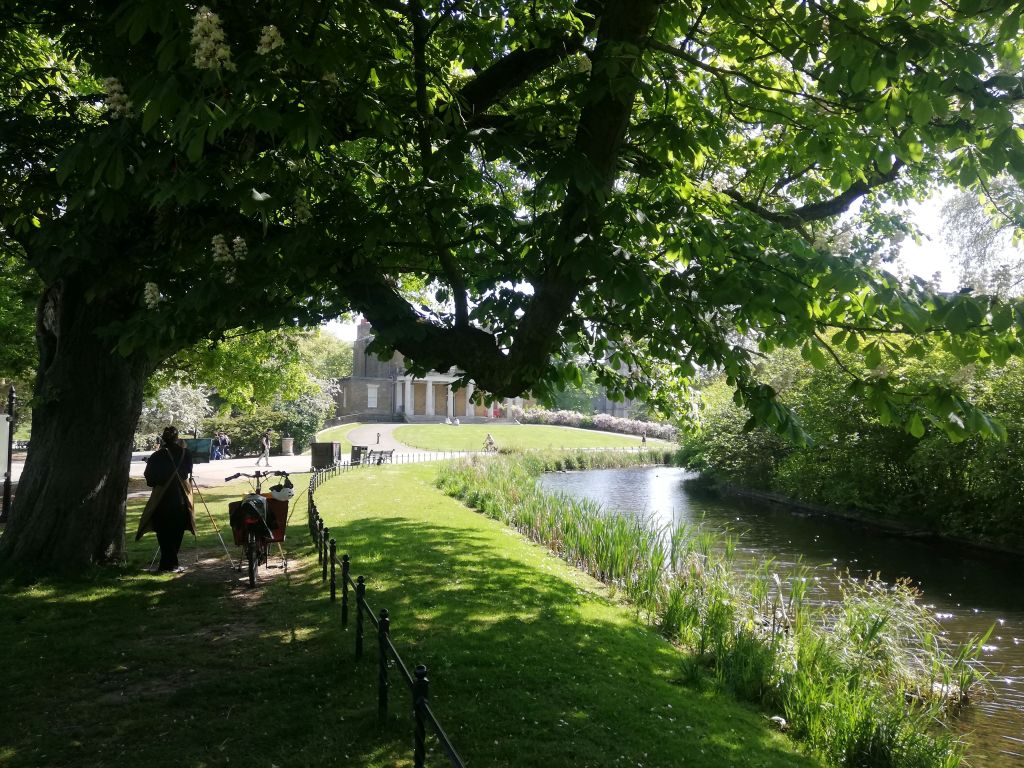
An artist painting a scene at Clissold Park, north London.

From Dad’s home on the northern fringe of Muswell Hill, I cycle the sunny morning up and down through Turnpike Lane and along to Clissold Park, stop for an energy shot guarana coffee. Slide down to Dalston, get lost on a wrong turn to Victoria Park, open Google maps, eventually find my bearings roundabout to Mile End; Limehouse, and the minutiae of back streets and alleys, bridges and footways that lead to my dentist in Canary Wharf. It’s my first time there – my usual dentist has referred me to a private specialist, since the NHS nor even she privately has the necessary equipment for the job. Apparently I am at my destination but I can’t see it – no sign. I began panicking a good half hour earlier when the map was messing me around, sending me on wild goose chases, unnecessary side routes when the main road would have been fine and so much more direct. I think, AI could do a better job and I welcome that. I felt my cortisol level rising as I shifted from calm pleasure on my ride, to anxious nervousness, noticing how that made it harder to read the map or any useful information around me. I wondered if that was because of how expensive the consultation was, and difficult to get a slot, or because I don’t like being late for anything. Both. I’d actually left plenty of time so it felt punishing and I actually shed a tear.

Still, it was fine when I arrived. After I parked the bike, I noticed a small sign for a dentist. No name of the company, just dentist; so I called there. It was them! I’d thought I was 15 minutes late to a half hour appointment but it turned out she was running late, and all was fine.

She was very thorough and clear in her explanation of the predicament of my root. She spoke fast and showed me diagrams. She had a kind manner and I trusted her, but the treatment would cost about double what I had expected, plus she recommended that I get something else done by my dentist. I knew I must follow what she says, but the cost was going to be considerable, and I would notice it.

Now I think, how apt to be nodded toward this event so anxiously, when it will in fact set me back noticeably. A nudge that this will force me to do things differently perhaps. When I try to choose a payment plan for the dental bill, the system won’t let me, because I don’t earn enough money. The injustice that the poorest who need it, can’t access it. It must be a single big chunk or not at all. I wonder if I should ask my ex, or Dad to help, but neither seem like good options. It’s probably time I just bit it. It makes me want to cry. Self pity? Maybe. It’ll pass and I know it’s also good because it urges me to work harder, make more money, be more mindful. Understand the value of things.

Why have I been so blind to this coming? The bill is teaching me about money; to value it; to create it. And about following my guides. Sometimes I wait too long and they spend years trying to push a message across. I could become much swifter in my response.

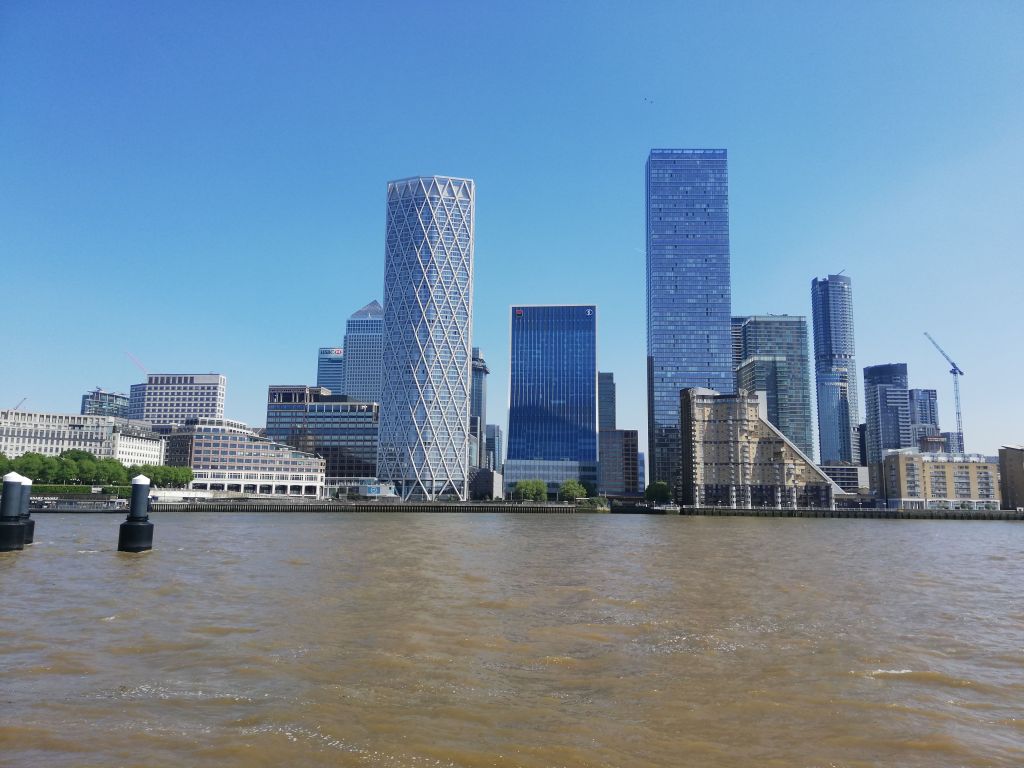
Cycling back I decided to drop into my dentist on the other side of the water, so for the first time, I took the ferry. Funnily enough I remembered at the beginning of the year hearing a message from my guides telling me to imagine I was very rich. I knew why – because that would help attract more resources, but I perhaps hadn’t followed the advice enough. They knew I was going to need more money than usual this year, and I wouldn’t have a partner who could help. A few weeks later I bought flights, transport and accommodation for a long trip to America. Now this. I have already increased the amount I am working, and that must continue!

The view after crossing the Thames, looking back at Canary Wharf.

Later in the day at a private view I don’t know who I’m going to see – random people, some artists I know… on a warm evening in Primrose Hill. The surprising thing is I spend most of the time speaking with two people I didn’t know previously. An American guy who wonders about going back to spend time with elderly parents. But the unexpected encounter which colours the rest of my evening is with an artist’s wife, who is an academic. First she speaks about a recent visit to the US, and then I ask if she is South African because of her accent, I mean I know she is. I say my family were; I ask when she moved here, and say mine did in 1963 as they were political (anti-apartheid). A light goes on in her and she asks my surname. I say Bunting and she says she knew Brian and Sonia personally – my great uncle and aunt. Like them, she was a member of the ANC movement and her aunt was their neighbour in Highgate. She attended meetings in their house and knew how dedicated they were. She even knew of my great grandfather, who very few people have heard of now! This was a rare happenstance meeting, sitting on the garden wall outside a gallery.

What strikes me most of all, is that I feel she understands me in a unique way; like a beam shining through me, I feel seen in a way very few people can. She has a deep insight into the way South African exiles in particular processed their situation and has studied it. The way the women often turned to writing, and how well they did this. She has written about this phenomenon and may send me a chapter of one of her books. Not that I am an exile, but it is a latent part of my heritage, and for some reason I connect with it while not all descendants do.

She understands how some of us are intrinsically compelled by our ancestors – their stories ignite us, give us more meaning in our own lives somehow. We need to look back because we see the traces in our lives of why we are where we are, and the trails are curious. When our family before us chose difficult lives – or rather couldn’t help but follow their calling to do what seemed right – because they had powerful beliefs, not just about how they lived but about the whole world or economic social system; they send ripples for generations after. They are often not the best parents because they are so caught up in their beliefs and must live with the consequences like spending time in prison; however they make great ancestors.

Somewhere down the line comes a descendant whose parents were not able to be more present, and she reaches back keenly to feel for messages from the past. It’s like filling in a parenting gap in my sense of purpose. It makes me feel special and it’s part of my identity. It’s not a whimsy; when I read the words they wrote, or were written about them, I feel a bolt of electricity running through me. I feel connected to them, and sense how they knew they were writing or making history not just for their own era, but for a bigger time frame. Writers reach across time, speaking to each other and their readers. When I learnt of how some of my ancestors had such powerful beliefs that it changed their lives as well as contributing to movements towards eradicating racism, undoing colonialism, and lessening the extreme effects of capitalism; it blew my mind!

I’m also deeply concerned with the present; the now; and meditate habitually; try to live in that place. As for the future, I am excited about evolution and spiritual development of humans, and moving beyond physical form. Timelessness intoxicates me. So there are these simultaneous fascinations.

We had begun our discussion about my American communist Grandpa, so she knows I have this extremity from both sides. She looks at me so acutely, and after that I can’t speak to anyone else. I can’t do small talk. I have to leave. I message Brian’s daughter, my Dad’s cousin, on my way home. It’s good to reconnect.

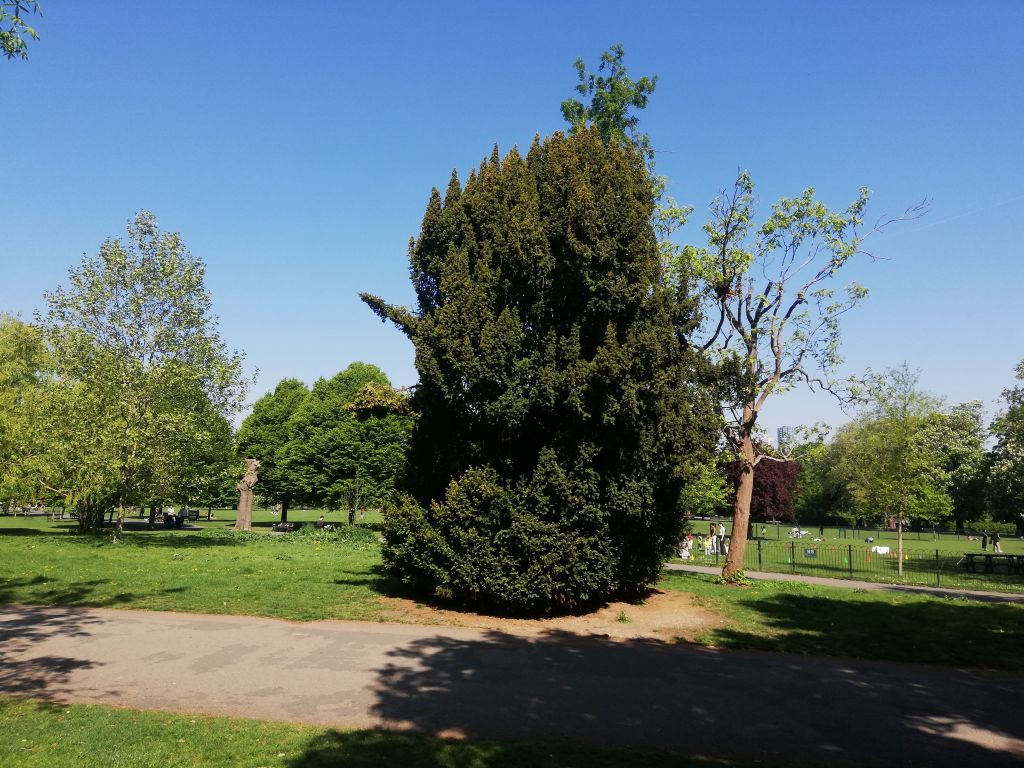
A tree in Clissold Park.

Lockdown Rewind ~ part 4

How do we stay relevent in lockdown? I feel for the doctors, nurses, hospital and other medical staff who have been pushed to their limits and exposed to the highest risks, on the frontline of the pandemic. All the essential workers; and some who lost their lives as a result. Many are not paid or appreciated enough. They weren’t or aren’t looked after properly for a long time, and I wonder how the teachers are now. There are other jobs too that keep the wheels of society’s machines oiled, like my partner working for the council. They don’t all have to leave the house, but they are needed, and often their workloads have increased in the stressed circumstances of the changeable pandemic.

Being an artist can feel like a luxury that is not strictly needed, along with other jobs and roles not deemed necessary enough for the risk to be accommodated. Some have been able to thrive or at least get by, making their work online instead. There are advantages, but so much is missed that way as well.

I was a bit lost in the Summer, unsure what to do with myself. Really allowed myself to feel the emptiness, the gap in my life where work had been. I’d gotten a lot from gardening earlier on, at a time when things felt so scary we weren’t sure which way the world might go. But the garden had been sorted, and was just busy quietly growing vegetables. Beyond a bit of watering and harvesting each day, it was taking care of itself.

If I wasn’t going to make my work online, then what? Sensing I needed a focus, Steve suggested I go to college; study something. When he said that, there was just one thing I thought I’d like to do. There are lots of subjects I’d like to know more about but wouldn’t require going to college. Training to be a counsellor however, seemed like something I could either do, or make use of in my work in a more artistic medium, so I looked up the options.

I wanted somewhere local so I may benefit from in-person teaching if it was possible. The local Higher Education college a couple of streets from where I live had an open day imminently, where it was possible to enrol. I booked a place to check out the Level 2 counselling skills course, and during the day I spent there, much of it waiting or filling out forms, I did enrol. Something new was going to happen and I was excited! I’d had to complete a 500 word essay as part of the application process, and sat in an empty art room alone, describing a period of change in my life. It flowed out without hesitation, and I thought, I could get into this subject. I’d just written a 4000 word blog post about gender inclusivity, so this felt like a picnic.

When it came to the actual enrolling, after a long queue, the guy who saw me asked about my employment situation and finances, and quickly surmised I was eligible for a free place. This was going well. The thing that absolutely sealed the deal, much more important than the fee in fact, was this course would be taught in-person. I was thrilled. I would be in a class with other students and a tutor once a week for 5 hours, over 18 weeks. That was an enriching prospect and I was looking forward to learning something new.

I had one major performance gig lined up for the Autumn in November – at an eco-feminist festival organised by Art from Heart. As well as going to college, I needed to prepare a show, and I was potentially starting from scratch. It had originally been scheduled for April… and if it had been then, I probably would have performed a version of ‘Growing Roots’. I was aware however, that show did not really fit the theme. Which goes to show how much I wanted to make that play, because it didn’t have any sort of commission, or fit with anything I’d been asked to do. Although Dani at LifeArt Stockwell‘s openness to me performing however I wanted, gave me a supportive space in January 2020.

Now I had more time, and had psychicly moved on from ‘Growing Roots’, it made sense to think afresh about this performance. Where on the eco-feminist spectrum did I incline to zone in? While that is a theme close to my heart, when it comes to feeling an artistic drive towards writing a story, the means of being hooked are not always obvious. There was however a guideline from my friend Judit, who runs Art from Heart, especially for me. When I had performed at her festival in 2019, I had created the ‘Roots’ show, which only loosely connected to the ecology theme. About some of my activist ancestors, I’d sourced original memoirs and letters to tell much of the narrative, plus written one monologue so that at least one female character could speak. The play had overall been received very well, presented largely as an audio piece with visual tableaux on stage.

Judit’s suggestion for my contribution at her next festival had been, “Now write just about your female ancestors”.

What an interesting and valuable instruction! It would have to be more fictional, and to be credible, involve plenty of historical research. A very thoughtful exercise, essentially rewriting history with some of the untold stories, imaginatively drawn to fill important gaps. To rebalance my ancestral blueprint informing who I am – but the wider symbolism meant adding to a growing shift in awareness about women’s and non-binary part in the past, as well as going forward. It’s a shift which I believe helps to heal everyone including men. I sometimes wonder how much I am affected, influenced by there being a long line of men on one side of my family at least, who we know about, have been written about. They are considered important and relevent. It’s also true that some of the women were prominent in their own right; but that wasn’t impressed upon me as I was growing up, the way the men were.

Judit’s suggestion feels timely, welcome, and currently I am eagerly immersing myself in it. Before the course began I got stuck into the new enquiry, probing Dad for useful documents (he is the family historian) as well as searching online for material about the era, movements of the day, and known figures involved. Very quickly a Victorian cast of torch bearers and trouble makers opened up, and I knew I’d have no problem generating drama. Of course the November date was cancelled – and didn’t go online – but we are now aiming with hope, for October.

The featured image above, is of me performing my great grandmother Rivkah. Below I am performing my grandmother Mary, as well as the statue of Liberty. Both images are taken from the ‘Roots’ performance in 2019 at ‘We Grow into the Forest’ festival. Photographs by Judit Prieto.

Making Roots

For a while, a few years now I have had the privilege of being able to visit some of the places where my ancestors came from, and where my parents grew up. As a white English woman I was perhaps late in life to identify as a second generation migrant, after all, three of my grandparents lived in England. Yet when I submitted a script of a play I’d written about my family (a very different play) in 2009 to the writers’ department of Soho Theatre, the feedback I received was to make more of my cultural background, and to connect with the diaspora of my people. This was not what I had expected, however I realised that a few lines had been misinterpreted as indicating my perceived Jewishness. It was an eye-opener that served to illuminate further to me how unusual my background was, and also to be aware of how I may be read so that I could then be more in control of that.

I had lots of research to do on the places and people I actually come from, and various pieces of the story emerged at different times. Some were already known to me. In 2008 I can’t remember why I decided to start reading the memoirs of my maternal grandfather (known as Gramp), and as well to type some of them up so that we would have a digital copy. The copy we already had was faintly typed on very thin, yellowing East German paper. We’d had it for years, since my childhood and for some reason as I approached my 31st birthday I gained an interest in the papers. Gramp was still alive and nearing his 97th.  Then suddenly a few months later, out of the blue he died, and we travelled to Berlin for his funeral. It amazed me that he’d died just as I was getting interested in his story – which was long and I had only tackled a small part of it. Well, he had been very frail for years, in fact I had visited him 10 years before in 1998, sent by my Mother to be her ambassador as she was too unwell to visit him. On that occasion it took him a while to determine who I was. Hearing my voice he asked in his American accent, “Are you from London?”

His memoirs cover most of his life, from birth including what he knew of his ancestors, up until his early 70s when with long hours alone he wrote them. There were passages which did not really interest me, but then it was like striking gold when a cluster of paragraphs stood out describing childhood scenes on a farm, or being on the run from conservative agencies during the McCarthy era. It was fascinating social history and information about some of the forces that even shaped my life. Unfortunately my pursuit of the long typing needed faltered and I only recorded a few sections that year, but nevertheless I knew the material was waiting and my appetite had been whet.

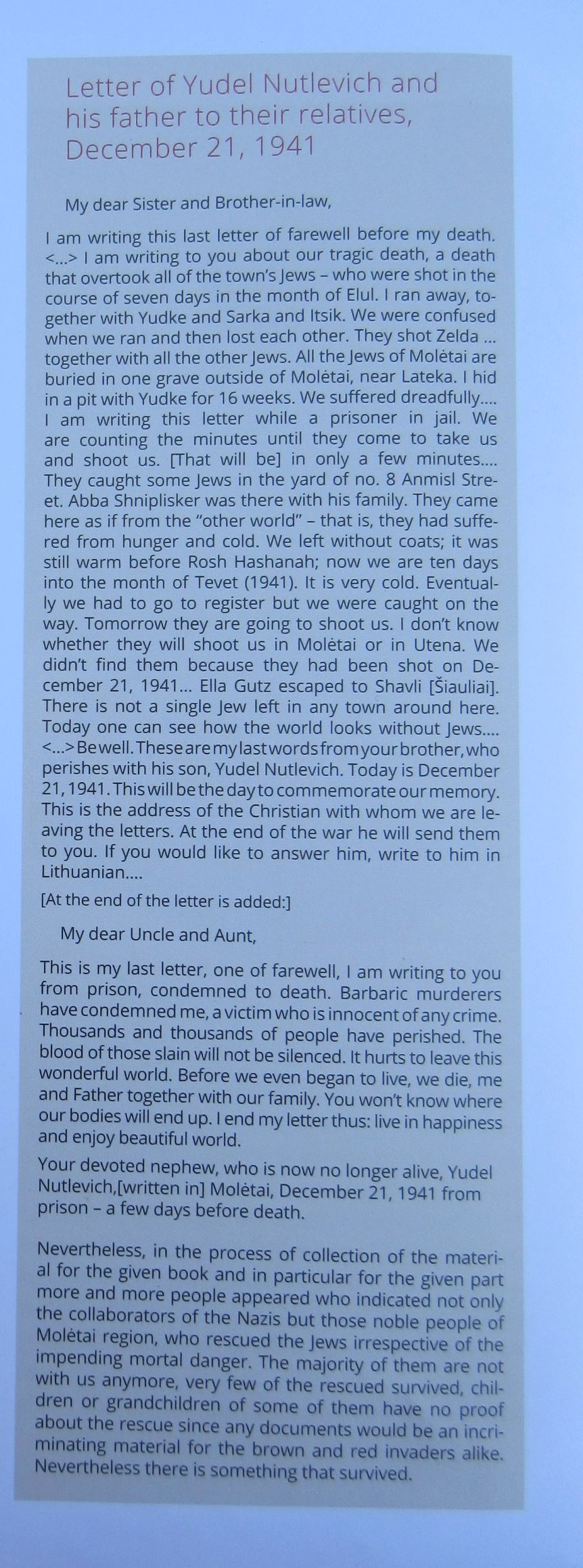
Pictures of Moletai in May 2018

Last year my partner Steve and I visited Lithuania, and spent time in the town which had been a village, where one of my great grandmothers came from. Moletai (pronounced Molyati) had been about 85% Jewish in those days, including this branch of my family at the turn of the last century. We have no family or connections there now, as my family left in 1911. The fear of pogroms was very real, and Jews who did stay were rounded up the following year by the Soviets. Some were later freed, but in years to come the situation worsened, culminating in the Nazis finishing off all Jews in the area in 1941. I had not known all this prior to visiting, however the town is blessed with a cultural centre and local history books tell the people’s story.
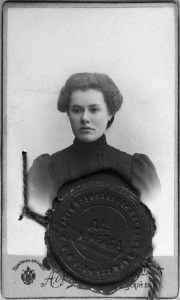

Rivkah Notlevich in Lithuania, 1908

There were old photographs which reminded me of the style of photograph we have of Rivkah, my great grandmother. There was also a letter printed, by a man bearing Rivkah’s same surname, albeit with one letter different. She was née Rivkah Notlevich, and he was Yudel Nutlevich; and I thought having seen all the graves inscribed with Hebrew, that there may easily have been inconsistencies in translation, also from Russian/Lithuanian. Yudel wrote shortly before he was to be shot in 1941, and entrusted the letter addressed to his family with a Christian neighbour. To say it moved me is an understatement. It described how everyone they knew had been murdered, he himself had hidden for 16 weeks in a pit before being found.

“This is my last letter, one of farewell, I am writing to you from prison, condemned to death. Barbaric murderers have condemned me, a victim who is innocent of any crime. Thousands and thousands of people have perished. The blood of those slain will not be silenced. It hurts to leave this wonderful world… you won’t know where our bodies will end up.”

Imagining him as a distant relative I suddenly felt connected with a deep lost strand of my history, and for the first time in my life felt some Jewish identity, or rather it weighed on me what that could be like. Rivkah herself was not interested in religion, instead politics drew her and she became a committed socialist from an early age, whilst in Lithuania. Judaism was not passed on by her as she married out and only had sons.


Jewish cemetery at Moletai

There were many memorials to the thousands of Jews killed and I learnt just how large an area they had been eradicated from, throughout many parts of Eastern Europe. I have always felt critical of Israel’s anti-Palestinian policy and still do, but a change occured in how I felt like approaching the subject. I was overcome with compassion as I understood to what extent Jews had lost their lives and homes in several countries, and it would have been very difficult for them to feel safe.

Rivkah’s family eventually settled in Johannesburg, South Africa which I have not been able to visit yet. It is high on my list as there are many places there I would like to go to as that’s where my Dad was born, and his Father’s family had had a presence there for almost 200 years. A missionary called Jabez set out to preach Methodism, and a mission named after him – Old Bunting, later Buntingville – was established in 1830 on the Eastern Cape of South Africa. This character was known to me by a plaque unveiling I attended as a child, in a square in Angel, London where he’d lived, as well as a severe if smiling portrait of him at my grandparents’ and later my parents’ house. A further detail was revealed when during an English A Level class his name appeared in the introduction to Emily Brontë’s Wuthering Heights! A strict and unkind priest was based on him.

As if to redeem the family from this authoritarian presence, some generations later when the family had already become more liberal, his great grandson called Sidney went a few steps further, and became a radical black rights activist and politician in South Africa during the 1920s. He succeeded in shifting the South African Communist Party’s policy and focus to being led by black South Africans (it had been all white and not keen to embrace the native population), however this was an extremely tough battle which ultimately cost him his career; life even. It is a sad story yet Allison Drew’s ‘Between Empire and Revolution‘  beautifully shines a light on all aspects of his life and tells the whole story in detail. This book had been in my possession since my Dad gifted me it when it was published, though I only read all of it last year when my trip to Lithuania ignited my interest in any information about Rivkah – who became Rebecca. The only documents about her relate to her husband, Sidney and there were a few sections that were pertinent in the book, as well as in Sidney’s ‘Letters to Rebecca‘, which also includes one letter by her. Theirs was a most extraordinary and inspiring tale, and I feel enormous pride when I think of Sidney and Rivkah.

The Roots play follows the stories of Rivkah and Sidney from my Father’s family, and of John and Mary who were my maternal grandparents. All the sources of writing were fascinating, it is just unfortunate that neither woman left writing in her own right. That is only partly because of the time they were in; with Sidney and Rivkah it is true that women at that time and place were not in such prominent positions yet. For John and Mary however in the socialist world a generation later, she had just as many if not more opportunities than him, career-wise. It was rather that he lived longer and was more alone in those years so had time to record his memories. I think he also had more reason to, since his journey was more dramatic, living in exile from the age of 37. Without his words, his descendents would not have knowledge of their ancestral past, since the cold war climate had separated us long ago from his living family in America.

Mary was an artist and fashion designer when she moved back to London, and left many embroideries, tapestries, drawings, clothes and jewellery. Reading between the lines and sometimes directly from Gramp’s memoirs, as well as what I remember of her, I identify a great deal with Mary’s vitality, creativity and strong spirit of independence. She was also a socialist feminist! It therefore seems odd perhaps that she doesn’t have her own voice in the play, unlike Rivkah whom I had penned a monologue for shortly after my visit to Lithuania. Writing the play was partly piecing together sections of text I’d written and collated over several years in fact, and rereading all the letters. There may be unfinished business, but in a way, my own voice may be closest to Mary’s which may account for the absence.

Coincidentally both families partly moved to London in 1963, to the same unique part of Highgate – Holly Lodge Estate. It is through this connection that my parents met, and I believe that the stories contained in the play may partly explain their attraction; on some level recognising shared and unusual family pasts of extreme left dimensions and political persecution. It is also true that both my parents, coming from these activist origins, did not feel drawn to continue such a path. Growing up in families where politics may have been more important than family, and where you’re on the losing side even if righteous, may sometimes be a strong antidote to choosing that oneself.

Presenting the play with my usual life drawing formula was a stretch with subject matter not remotely relating. I used some costumes but also opted for nudity quite a lot. It is my natural medium, however a few audience members rejected the approach as inappropriate. Others appreciated the art interpretation, and perhaps that my own passion for nude liberation is in some way borne of this earlier family idealism. The life drawing did also fit well with much of the text being audio based; static tableaux could be drawn whilst the audience listened.

I performed most of the show solo, and as well for a few scenes invited friends and audience members to join in whether nude or not to create group tableaux. It was very helpful to have a man posing to represent my Grandfather, whilst at other times scenes were illustrated by enactments of famous paintings from the time. We recreated ‘American Gothic‘, and I posed alongside works by Chagall and Popova.

During the first scene, about Rivka’s life in Moletai, I played a video I had made there of myself performing a menstrual ritual in one of the nearby lakes. Pouring my own blood into the water of my once Motherland was a way to connect with a place now lost to us. This practice has been part of my work for a few years, such as a time I was on the trail of a Grandmother not included in this show, when she lived in Tanzania.
Finding the voices for the male characters didn’t come straight off. I was fairly quick to pick up on Dad making an excellent Sidney, but the American voice was harder. I searched and people answered, but I wanted personal connection, feeling a little precious of my project. There were a couple of guys who nearly did it, then didn’t, and as time was running out I wasn’t sure what to do. At short notice I asked my brother, and to my very pleasant relief he came good and we discovered a previously unknown (to me) talent! Recordings were crafted and I selected music to add in the mix. Steve kindly created these with great care and fine tuning. I fell in love with those recordings! Like a movie soundtrack or a radio play I wanted to keep listening to. Which was lucky as I had to rehearse fast and the lines weren’t coming quick enough.

I had overstretched myself and foolishly gotten Steve booked for another gig the same evening as my first performance. So I was on my own and this was a very technical show – projector, sound and visuals to coordinate with live action cues. I was a bit stuck but luckily my friend Anastasia agreed to help. She was at first unkeen, being unfamiliar with these things, but I was desperate and the main thing was having a mate there. On the night it was a bit chaotic, but we did it and had an amazing audience. The show was part of a festival of events and an exhibition called ‘We Grow into the Forest‘, as curated and organised by my friend Judit.

For the second performance at Telegraph Hill Festival, it was a smoother flow and it was great to have the opportunity to see that version of the play grow through the duration. I think there is much I would like to add to it, from the voices already included but also more about the women, and other characters and narratives that didn’t make this cut.

Why Roots now?

Judit asked me about a year ago to make a life model based performance and workshop for this event. I had suggested myself as the model since it was unknown if there would be funding, and besides I have a few images of myself with trees, or nude in natural surroundings, which related to the theme of trees and nature that ‘We Grow into the Forest’ was about.

When we returned from Lithuania in late May last year, Mum was in hospital and died ten days later. This shook my world, our family’s world, and grief is a long unfolding. While this is still so raw, and in fact she has been the subject of much of my art over the years, it felt easier to go back further into the past this time and untangle some of the knots. I mean, on the one hand Mum has been very much on my mind and with me these last months, but on the other I am not ready to make her the subject directly again.

I have learnt a lot from this gathering of information and still there is much more to do.

Here is an audio version of the Roots play.