
Back in 2007 I began life modelling for a handful of artists my sister put me in touch with. She had modelled as a student and handed her contacts over to me when she emigrated not long after leaving college. Peter Hall was and still is an artist and model who ran a few groups and his small friendly Vauxhall session was my first. After that I knew I could do it and was pretty good as well, even as a brand new model. I had trained in physical theatre and was working as a jobbing actor. In the past I’d worked in various states of undress in adult entertainment shall we say. I’d also learnt how to meditate a few years before. So making shapes whilst nude and holding still for an audience of artists was not a problem in the slightest, in fact very enjoyable.
Another contact was a watercolour life painting tutor at the CityLit college, so I got employment there, and also at Heatherleys School of fine art. Once I got acquainted with Heatherleys I realised this could be a full time job. It was very easy to quickly be booked there all day everyday and possibly evenings too, plus weekends. It wasn’t in one’s best interests for mental health to be there that much however*, and in any case there was plenty of other work coming in too from all sorts of directions. I hadn’t fully appreciated at the time how it happened that I became a life model just before an enormous upsurge in the popularity of life drawing was about to take place. It was intersecting with a few cultural zeitgeists all at once. The British taboo/fascination with nudity; a trend in the art world swinging back to embrace the tradition of life drawing; and a soon to be emerging movement for body acceptance as well as personal empowerment. Little did I know those last ones would be very significant for my career in a few years.
Other factors affording the incredible proliferation of the life drawing scene in the UK since about 2009, include a flexible bureaucracy enabling people to easily start up their own groups – to hire spaces and book models. Such a system does not exist in France or some other places on the continent for example, so even though they have very important art centres, there are curbs on innovation and the pursuing of individual projects. I have always valued that relatively relaxed state of play we have, making it possible to realise one’s dreams in quite simple ways. It was even more relaxed when I first began as at that time, an undocumented migrant could work as a life model in many of the institutions who still paid cash. That has changed. There are also more safeguarding procedures now in art centres making it incumbent on organisers and models to have certain certificates, whether DBS for working with children or vulnerable adults; or public liability insurance; sometimes for first aid; as well as getting any electrical equipment safety checked.
From 2010 life models began to get together in a Facebook group called Life Models Only. It was very exciting, the first time we were connecting with each other not only with other models in the same city, but across the UK and sometimes from other parts of the world. A tandem group for life drawing artists and models which is still going is called LifeArt. That was always a very international space, but more artist led. Prior to and alongside the Facebook groups some of the London models had been gathered together in an email group by model Lucy Saunders. I met her at The Mall Galleries (Hesketh Hubbard) since they would book 4 models each Friday evening. She was keen that we should join up, share jobs, and organise to raise the pay and improve conditions. A union!
She arranged meetings in person as well, and shared life model news via her newsletter. We would offer jobs to ‘The List’ as it was known if we couldn’t make them ourselves. It was extremely helpful, and we could warn each other too, if an artist had crossed a line, which was generally an experience that female models faced. It wasn’t commonplace, but it did happen sometimes, and then having these groups was instrumental. Once we were on social media, it was possible to effect change almost immediately. It wasn’t such a big scene, so if someone was misbehaving, soon everyone would know.
More often it was to warn of a venue which was particularly cold, or didn’t offer enough breaks! Or the changing space was unsafe, or the artists demanded very challenging poses unsuitable to the model. In this way we would learn about each others’ circumstances, and how the job was a bit different for another kind of model. For example, some gigs were only booking female models, and some were only booking dancers or slim young female models. Others loved more variety. There were fewer fat models so they could be more in demand, but some places didn’t want them. There was a scarcity of models of colour, apart from a few main players including Morimda and Matthew who were both long time black models. It was very difficult to find Asian models.
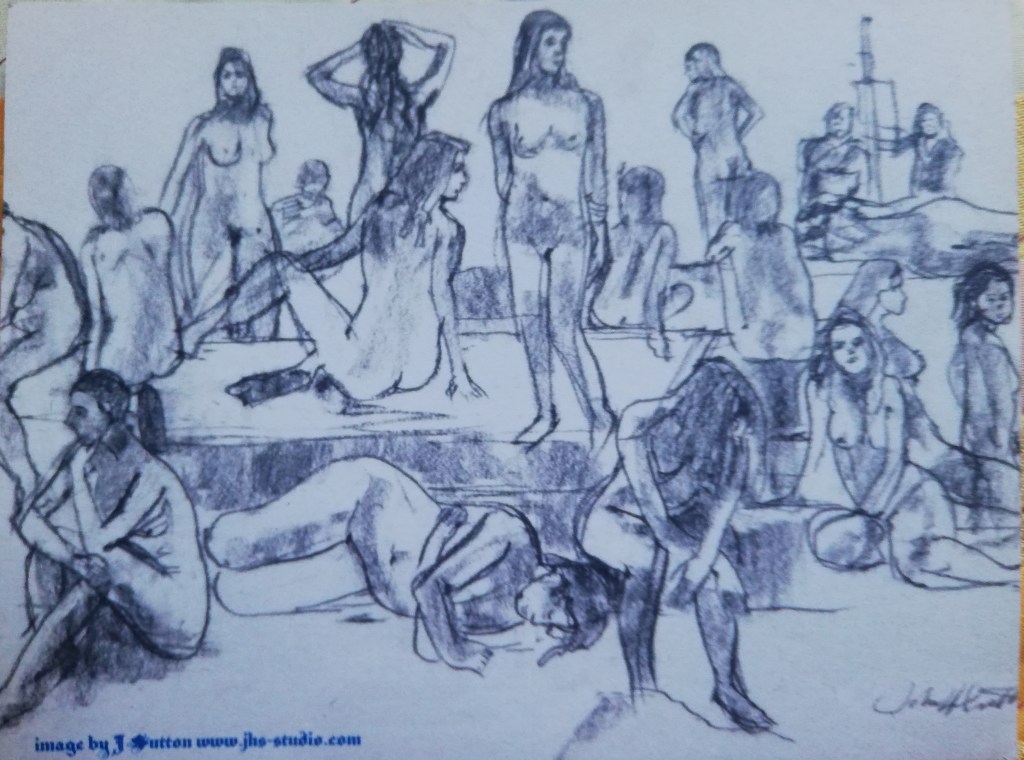
It was towards the end of 2010 I received an email from Morimda, who was creating an art project where life modelling would be used as a tool to empower women regarding their body image. She wanted Lucy to be on board since she was a big networker, and she invited me as well, as I was also very experienced and articulate, and importantly online (at that time some of the old school models eschewed social media). We were going to put on an event at The Mall Galleries and invite 20 women to take part as models for their first time. The artists were up for the challenge. We would guide the new models regarding how to pose. In the end only 9 women took part, but even that was a considerable number of people to have modelling simultaneously. It was a wonderful sight to behold and I felt very proud of our achievement. We had prepared all the women in advance, and monitored their progress afterwards by staying in touch. Some became regular models. It was an overall success, only Morimda had had to back out of much of the organising in the run up. I did a lot of it myself and with Lucy. Truly it brought out something in me which hadn’t previously had an outlet; some kind of ability to lead and guide. I immersed myself in the project and it felt very rewarding. Morimda had to let go of it after the first event for personal reasons and she asked me to take it on, which I gladly did. The project was called Spirited Bodies and it is not exaggerating to say that it changed my life. That is another story for another post!
This post also features on and in fact was requested originally by Newington Green Life Drawing group for their blog.
 Esther Bunting